
Inside a Fragrance Museum: What a Scent Collection Teaches a Team
A fragrance museum does two jobs at once. It gives the public a way to smell history, and it gives a product team a place to calibrate its own nose. The second job is the one most companies underuse. Visitors leave with an experience; teams can leave with a shared vocabulary for materials, references and quality — and that vocabulary is far harder to build from a tray of blotters in a meeting room.
Key takeaways
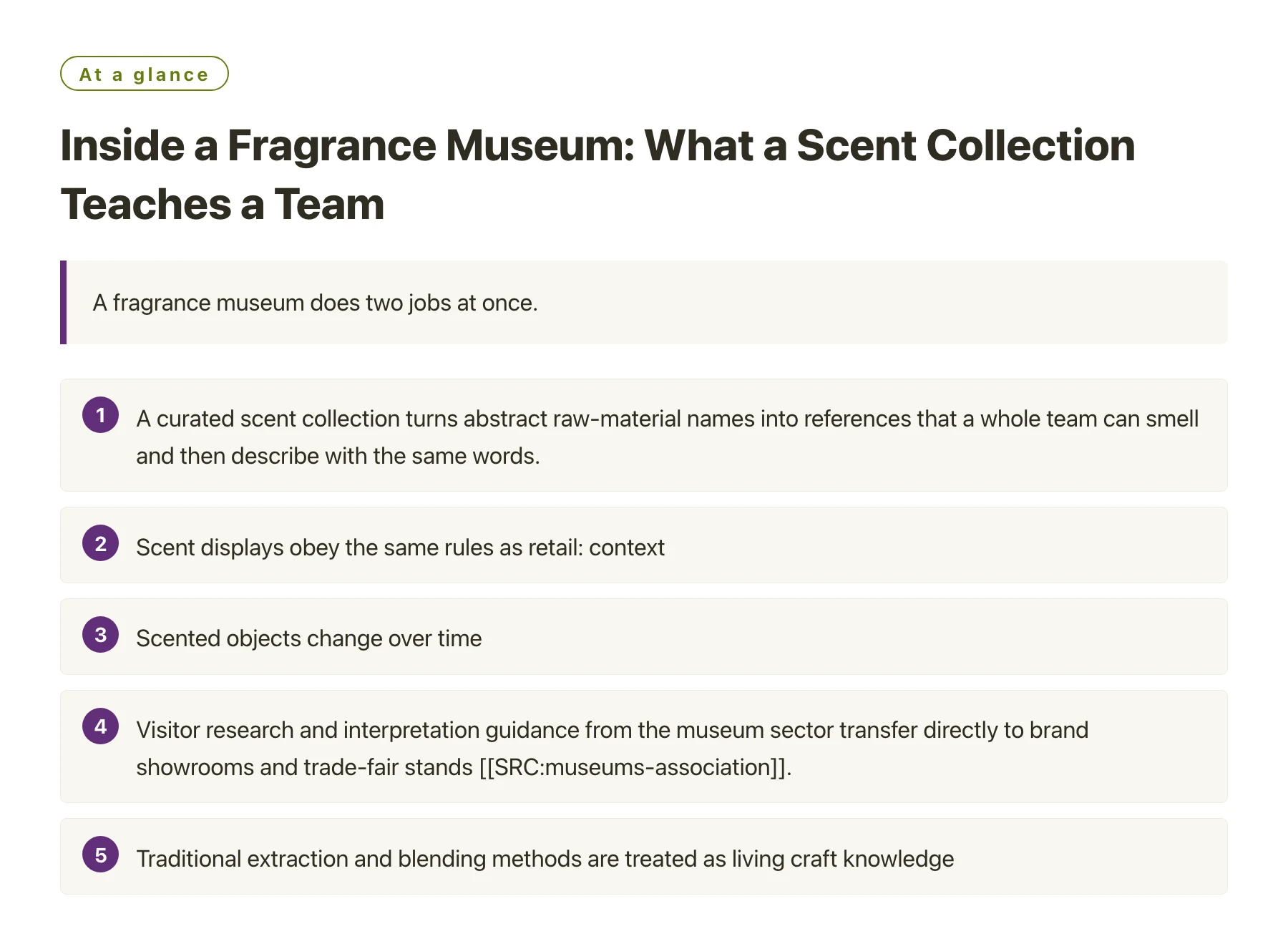
- A curated scent collection turns abstract raw-material names into references that a whole team can smell and then describe with the same words.
- Scent displays obey the same rules as retail: context, sequence and controlled intensity decide whether a material reads as interesting or overwhelming.
- Scented objects change over time, so a serious collection needs a conservation plan covering light, temperature and replacement of exhausted exhibits [1].
- Visitor research and interpretation guidance from the museum sector transfer directly to brand showrooms and trade-fair stands [2].
- Traditional extraction and blending methods are treated as living craft knowledge, which is why good exhibitions display techniques rather than only objects [3].
Walk into a well-built fragrance exhibition and the first thing you notice is not the bottles. It is the pace. Visitors move slowly, they talk less, and they tend to smell the same thing twice. That behaviour is designed, not accidental, and it is exactly the behaviour a brand wants from someone encountering its materials for the first time.
Perfume exhibitions are usually described in terms of spectacle: rare flacons, historical packaging, a darkened room, a scent released on cue. The spectacle is real and it is not the part that transfers value to a business. What transfers is structure — a route that lets someone compare two things and reach a conclusion.
This article looks at what a scent collection is actually for, how a route is designed, and how a manufacturer or brand team can use a museum visit as training rather than as an outing.
What a scent collection is actually for
Collections that stay useful over decades are organised around references rather than objects: a material, an extraction method, a period, a family of accords. That structure lets a visitor put two things side by side, which is the only way a smell becomes memorable rather than merely pleasant.
The objects still matter, but they serve the comparison. A bottle with no context is decoration.
Documentation is what makes an exhibit usable
Museums hold themselves to cataloguing and care standards for a practical reason: an undocumented object cannot be interpreted, lent, conserved or replaced. The International Council of Museums publishes the ethical and practical framework that most institutions follow, covering acquisition, documentation and the duty of care [1].
The same discipline pays off in a corporate collection. If each reference carries its origin, its method of production and the date it was last refreshed, the collection can be taught from instead of merely displayed.
Why a scent needs context to make sense
Smell is a poor standalone signal. The same material can read as sharp in one setting and rich in another, depending on what was smelled a minute earlier. Interpretation practice in the museum sector deals with precisely this problem, and its guidance on sequencing and visitor attention is worth borrowing [2].
In practice that means one idea per station, intensity that rises gradually, and a rest point before the visitor leaves.
Designing a scent route that visitors can follow
| Station | What the visitor does | Why it works |
|---|---|---|
| Orientation | Smells one or two anchor materials and nothing else | Creates a baseline before anything complex arrives |
| Material bench | Compares two versions of the same material | Makes a quality difference concrete rather than verbal |
| Construction room | Builds a simple accord from three notes | Shows a formula being assembled instead of admired |
| Heritage case | Reads a short history beside a reproduced flacon | Anchors the memory of a smell to a story |
| Rest station | Pauses in scent-free air before leaving | Reduces nose fatigue so the visit is remembered accurately |
The sequence matters more than the inventory. A collection can be modest and still teach well if every station carries a single idea, if intensity climbs slowly, and if the visitor is given a reason to compare rather than to admire. That is also a workable brief for a brand showroom or a trade-fair stand, where attention is shorter and the temptation to display everything at once is much stronger.
The most common mistake in a corporate scent collection is treating exhibits as permanent. Fragrance materials evaporate, oxidise and fade, and a reference that has drifted is worse than no reference at all, because people keep learning from it. Build the refresh cycle into the collection from the first day: record when each exhibit was prepared, store spare material properly, and replace rather than top up. A collection is not an asset that appreciates untouched — it is a piece of equipment that needs servicing, and its value depends entirely on whether the smell in the jar is still the smell on the label.
Using a collection as a training tool
For a manufacturer, a museum is also an archive of intent. It records what a material is supposed to smell like, which is useful when a brief, a supplier substitution or a customer expectation has to be discussed precisely.
Two training formats work particularly well, and both need less time than a formal course.
Building a shared vocabulary
Ask five people to describe a single material and you will collect five different words, several of which contradict each other. Standing in front of a reference removes most of that ambiguity, because everyone is describing the same stimulus at the same moment.
The exercise is worth repeating at intervals. A team that shares words resolves disagreements about a sample in minutes rather than by exchanging further rounds of modifications.
Testing a brief against references
Before a development brief goes out, walk it against the collection. If the brief asks for a warm floral character, smell three materials that could reasonably carry that description and check whether the team agrees on which one the brief implies.
Traditional extraction and blending knowledge is increasingly treated as heritage in its own right rather than as a footnote to the objects it produced, which is why technique deserves a place on the wall alongside the finished bottle [3]. For a manufacturer, that framing has a practical benefit: it makes the method part of the story a client can repeat.
In Guangzhou, the company behind the Xuelei fragrance business operates a museum collection that the company describes as the largest of its kind, and the exhibits are presented at Xuelei's museum.
How to get real value from a museum visit
- Book the visit around a live questionArrive with one decision to make — a family direction, a market preference, a raw material to approve — so the visit has an output.
- Cap the group at the people who decideSix focused people smell more accurately than twenty polite ones, and a smaller group can stop at a station without blocking the route.
- Bring blotters and a notebookWrite the material name next to the impression at the moment you smell it, then revisit the notes the following day when the memory has settled.
- Ask for the technique, not the anecdoteRequest the extraction or blending method behind each reference; that is the part a team can apply to its own development work.
- Debrief before leaving the buildingSpend fifteen minutes agreeing on what the group learned and what changes as a result, while the references are still fresh.
Sources
- ICOM — International Council of Museums —— The international organisation representing museums; publishes the ICOM museum definition and professional standards for museum practice.
- Museums Association —— A professional body for museums, publishing guidance and research on museum practice and visitor experience.
- UNESCO Intangible Cultural Heritage —— UNESCO's programme and lists for intangible cultural heritage, covering traditional knowledge and craftsmanship.
Frequently asked questions
What is the point of a fragrance museum for a brand rather than a tourist?
It compresses material knowledge into an hour. Instead of reading descriptions of osmanthus, oud or iris, a team smells the references together and agrees on words. That shared vocabulary speeds up sample reviews and reduces the number of development rounds caused by misunderstanding rather than by the formula.
How should scent exhibits be sequenced?
One idea per station, rising intensity, and a rest point at the end. Start with a single anchor material so visitors have a baseline, move to comparisons, then to construction, and finish in scent-free air. Reversing that order leaves the first impression fighting everything that follows.
Do scent exhibits expire?
Yes. Materials evaporate and oxidise, and light and heat accelerate the change. A collection needs a documented refresh cycle, spare material in proper storage, and a rule that a drifted reference is replaced rather than diluted with fresh material to make it last longer.
Can a factory visit replace a museum visit for training?
They teach different things. A production visit shows how a formula is blended, rested and filled at scale; a curated collection shows what materials are supposed to smell like. Teams that do both tend to connect olfactive decisions to production consequences much faster.
How many materials should an exhibition show?
Fewer than most organisers expect. A route of six to ten well-documented references, each with a reason to be compared to the previous one, teaches more than a wall of a hundred jars. Volume creates fatigue, and fatigue is what visitors remember instead of the content.
Start your discreet consult
Board-licensed physicians. NABP-accredited pharmacies. Plain-box shipping. From $1.20 a dose.
Start Online Consult — From $1.20/dose