
Test Driving an XPENG in Australia: Ten Checks Worth Doing
Forty minutes is enough to test a car properly if you arrive with a list instead of a feeling. Ten checks cover the things that are expensive to change later — where the charge flap sits, how the assistance systems behave when they reach their limit, and whether the cockpit you are shown is the one the car will still have in three years. The New G6 and the X9 are both driven through the same booking route, and both are worth testing on your own roads rather than a dealership loop.
Key takeaways
- The charge flap is on the right rear quarter panel: press the top-left of the flap and then connect the cable.
- XPENG vehicles are compatible with most public Type 2 AC and CCS2 DC fast chargers, so test a public charger on the drive.
- XPILOT ASSIST is an assistance function: the driver must stay aware, monitor traffic and take over when needed.
- Scheduled servicing runs every 12 months or 20,000 km, whichever comes first, which is the number to check before you sign.
Five checks before you move
Do these in the car park while the car is stationary and the salesperson is still nearby to answer questions. First, open the charge flap. It sits on the right rear quarter panel; press the top-left of the flap and it opens, then connect the cable. Ten seconds of practice here saves five minutes of confusion at a public charger in the rain.
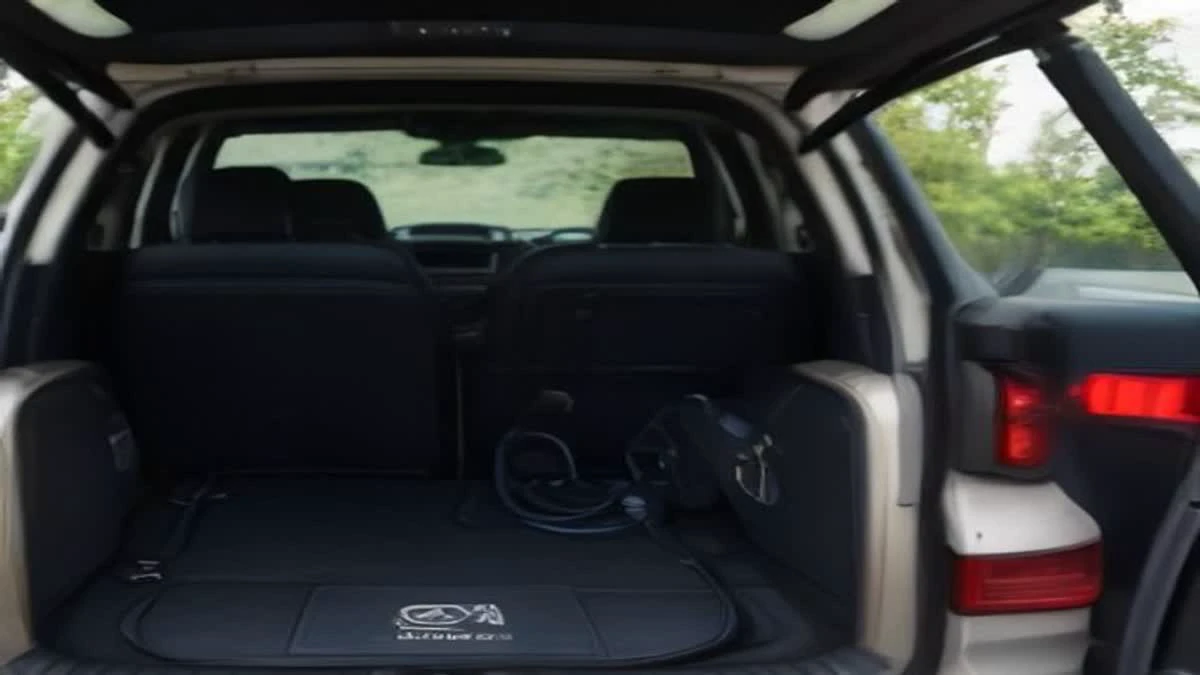
Second, sit in the driver's seat and set it up as you would for a long drive, then get out and look at where your head and shoulders sit relative to the pillar. Third, walk to the back and load the boot with whatever you actually carry, including the cable, which is bulky and heavier than people expect. Fourth, check the charging cable storage and ask where the home charging hardware would sit at your place, since the site lists plug-and-charge, a charging schedule, Smart Guard anti-theft locking and multi-account sharing. Fifth, look at the light bar and the camera hardware at the top of the windscreen, then ask which of the assistance features you are being shown are standard on the variant in front of you and which are options.
Five checks on the move
Ask for a route that includes a section of your own commute, not a loop around the dealership. Then test these five. First, the assistance systems: XPILOT ASSIST is published as an assistance function, and the manufacturer's footnote is that the driver must remain aware, monitor traffic and take over when needed. Test how it behaves when a lane marking disappears on a back road, because that is where the difference between a confident system and an unsure one shows up.
Second, the cockpit interface. The Xmart OS cockpit is described as OTA-upgradable, with updates delivered over Wi-Fi or the mobile network and in-car scene modes you can customise, so ask which version the demonstrator is running and ask to see the update screen. Third, seat comfort over twenty minutes rather than two: power-reclining Nappa leather seats are listed for the range, and the manufacturer notes that availability varies by configuration, so confirm what the quote actually includes.
Fourth, ride and noise at highway speed, because the fastback silhouette and long front overhang of the New G6 are aerodynamic choices that show up as quietness rather than as a number. Fifth, the regeneration setting: drive it in the mode you would use daily, and check whether it suits your passengers — some people find strong regeneration unpleasant in stop-start traffic and the setting is easy to change, but only if you know where it is.
What each check defends against
| Check | Published detail |
|---|---|
| Charge flap location | Right rear quarter panel; press the top-left of the flap, then connect |
| Public charging | Compatible with most public Type 2 AC and CCS2 DC fast chargers |
| Assistance behaviour | XPILOT ASSIST is an assistance function; the driver stays responsible |
| Cockpit software | Xmart OS cockpit with an OTA-upgradable interface |
| Seat adjustment and trim | Power-reclining Nappa leather seats, availability varies by configuration |
| Service interval | Every 12 months or 20,000 km, whichever comes first |
The checklist, in order
One, charge flap and cable. Two, driver's seat setup. Three, boot loaded with your own gear. Four, home charging plan. Five, assistance hardware and variant list. Six, assistance behaviour on a road without clear markings. Seven, cockpit software and update screen. Eight, twenty minutes of seat comfort. Nine, highway noise and ride. Ten, service interval and dealer location. Ten items, ten answers written down, and no reliance on memory afterwards.
Worked example: how long the drive needs to be
The arithmetic here is a labelled example about time, with every assumption stated. Assume the five stationary checks take three minutes each: 5 × 3 = 15 minutes. Assume a test route of 20 km, driven at an average of 40 km/h in mixed traffic: 20 ÷ 40 = 0.5 hours, which is 30 minutes. Assume four of the five moving checks are run during that drive at about two minutes of attention each: 4 × 2 = 8 minutes, with the fifth covered by simply asking a question.
Total: 15 + 30 + 8 = 53 minutes, call it an hour with the handover chat. That is enough for everything on the list except one thing that cannot be compressed — long-distance comfort. If you regularly drive long distances, ask for an extended drive, because a two-hour seat is a different product from a twenty-minute one.
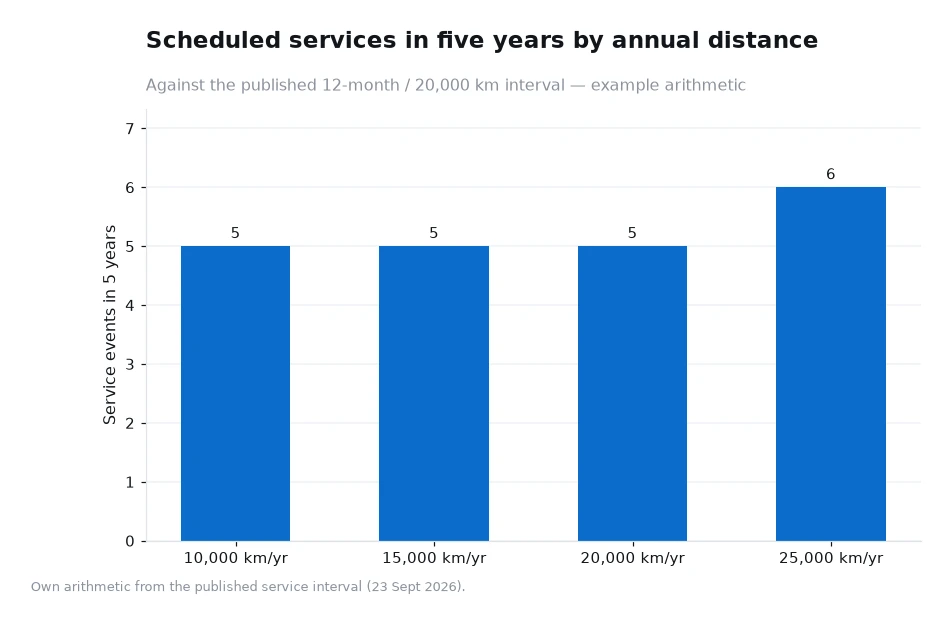
The same hour is a good time to settle servicing. The published interval is 12 months or 20,000 km, whichever comes first. At an assumed 10,000, 15,000 or 20,000 km a year that is five service events across five years, and at 25,000 km a year it becomes six, because the odometer reaches 20,000 km before the twelfth month. Those four scenarios are the ones plotted in the chart below.
Frequently asked questions
Can I book a test drive without visiting a dealer first?
Yes. Test drives are booked through the published booking route, and the dealer network listed on the site tells you which location is closest, so you can arrange the drive before any quote conversation.
What should I ask about the assistance systems on the drive?
Ask which functions are fitted to the variant you are quoting and confirm that they assist rather than replace you: the published note is that the driver must remain aware, monitor traffic and take over when needed.
What to do with the answers
Write your ten answers down before you leave the dealership, including the variant and the options fitted to the demonstrator, because memory flatters cars. Then take the same list to a second dealer and run it again; two drives on the same checklist tell you more about the car than one drive on an improvised route.
Everything on the list, along with dealer locations and the booking page, is published on XPENG Australia, and support is provided directly by XPENG ANZ. Book through the Test Drive page, find your nearest location with the Find a Dealer tool, and take the checklist with you.
Specifications, assistance notes and service terms come from the manufacturer's Australian site at xpeng.com/au, read 23 Sept 2026, including the footnote that XPILOT ASSIST is an assistance function and that Nappa seat availability varies by configuration. The timings, the 20 km route and the annual distances are illustrative assumptions for the worked example, not manufacturer data.[1]