
Adding a Shelf to a Shed: Fee Arithmetic at 1,552 TH/s
A small shed rarely fails because of the pool rate. It fails because the next shelf is added without checking what the next shelf costs. At 1,552 TH/s the gross is $58.97 a day, the listed 4% on the block-reward component takes $2.36, and 200 more terahashes would add $7.60 of gross for about $5.76 of power. That leaves $1.53 a day, and the whole decision lives in that number.
Key takeaways
- The current 1,552 TH/s earns 0.00069624 BTC a day, or $58.97 at $84,692 per BTC.
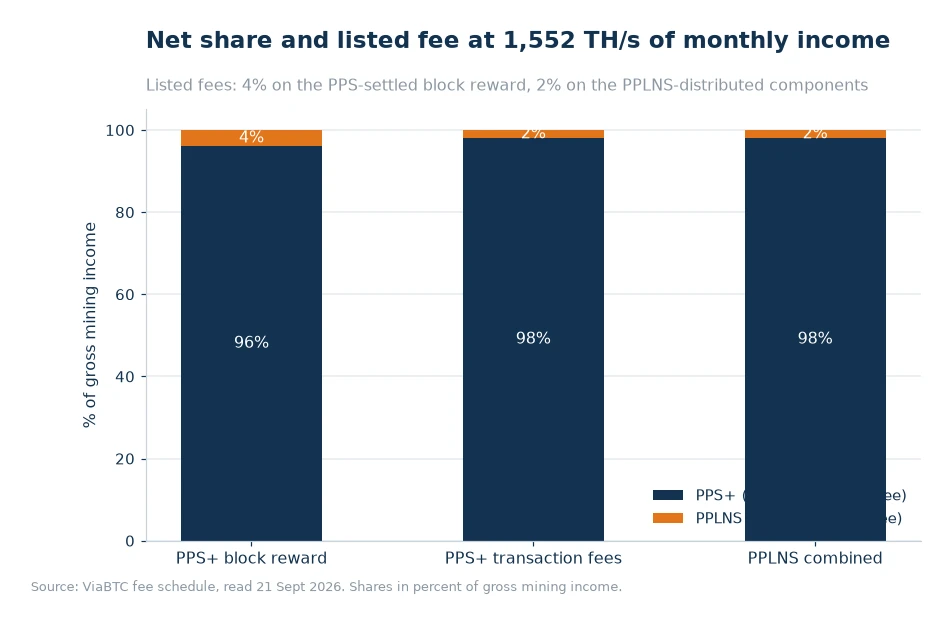
- The listed 4% line takes $2.36 a day here, and the listed 2% line takes $1.18.
- Each additional 200 TH/s adds $7.60 of gross, $0.30 of listed fee and $5.76 of power.
- The marginal margin of $1.53 a day disappears if the tariff rises above about $0.075 per kWh.
The shed has a ceiling and it is not the roof
Every small site has a limit that arrives before the building does: the feed, the breaker, the ventilation, or the patience of whoever lives nearby. Expansion plans that ignore the limit tend to discover it at the worst moment, usually when a new shelf is already installed and the main breaker trips on the first hot afternoon.
Writing the limit down changes the shape of the decision. If the feed allows 40 kW and the shed currently draws 31.04 kW, there is room for roughly 8.96 kW more, which at 20 J/TH is about 448 TH/s. That is a hard number, and it says more about the next purchase than any projection of coin price.
Marginal terahashes cost the same rate
The listed rate does not change when the site grows. A percentage applies to each new unit exactly as it applied to the last one, so expansion arithmetic is linear in the fee. The 4% line on the next 200 TH/s is 4% of that increment's gross, not a renegotiated rate on the whole site.
This is convenient, because it means you can evaluate one shelf without rebuilding the site model. Take the incremental gross, apply the incremental fee, subtract the incremental power, and you have the answer. The only place linearity breaks is the tariff, which often has steps rather than a smooth slope, and steps are exactly what a small site is most likely to hit.
The ViaBTC Pool Fees schedule states the two listed rates against their components, and that is all a marginal calculation needs from the pool side. Everything else in the sum belongs to the building: the feed, the tariff, the airflow and the space for one more shelf.
Both schemes scale the same way on an increment. PPS+ applies its listed 4% to the block-reward part of the new shelf's income and its listed 2% to the fee part, while a PPLNS account applies a listed 2% to both combined. On 200 TH/s the difference between them is 2% of that shelf's block-reward gross, roughly fifteen cents a day, which is real but small next to a $5.76 power bill.
What the next 200 TH/s adds
Two hundred terahashes is a plausible single shelf: five 40 TH/s units, or one modern machine of that size. At current inputs the increment produces 0.00008972 BTC a day, worth $7.60. The listed 4% takes $0.30, leaving $7.29. Power at 20 J/TH is 4 kW, which is 96 kWh a day and $5.76 at $0.06.
The remainder is $1.53 a day. That is the number to compare against the cost of the hardware, the space it occupies and the maintenance it will need. A shelf that costs $900 and returns $1.53 a day at these inputs takes about 588 days to repay itself before any difficulty change, which is a long time in a business where hardware ages quickly.
None of that makes the shelf a bad idea. It makes it a decision that depends on the tariff and on the price paid for the hardware, which is where the negotiation should focus.
The step that changes the tariff
Small sites often pay a rate that steps up once consumption passes a threshold. Adding 96 kWh a day can push a shed from a low band into a higher one, and the step applies to the whole bill rather than to the increment. That single feature can turn a $1.53 margin into a loss without any change in the pool rate.
Ask the utility for the band boundaries before ordering hardware. If the next shelf crosses one, price the entire bill at the higher rate and rerun the marginal sum. If it does not, the calculation above holds. Either way, the pool fee is a stable input and the tariff is the one that needs checking, which is the opposite of where most operators spend their attention.
There is a second threshold that behaves the same way: the feed itself. A shed wired for 32 A will not run two more shelves no matter what the tariff says, and the cost of an upgrade can exceed the entire margin the expansion was meant to create. Get the electrician's number before the supplier's invoice, always in that order.
Three sizes of the same shed
The table keeps the site configuration identical and varies only the number of shelves, so the increments can be read across rows.
| Capacity | Gross per day | Listed 4% | Net after 4% | Power per day |
|---|---|---|---|---|
| 1,552 TH/s today | $58.97 | $2.36 | $56.61 | $44.70 |
| 1,752 TH/s, one shelf more | $66.57 | $2.66 | $63.91 | $50.46 |
| 1,952 TH/s, two shelves more | $74.17 | $2.97 | $71.20 | $56.22 |
| 1,952 TH/s at $0.07 per kWh | $74.17 | $2.97 | $71.20 | $65.59 |
The last row exists to show how quickly a tariff change dominates. A one-cent increase per kilowatt-hour costs $9.37 a day at this size, which is nearly four times the entire listed 4% line. No amount of fee optimisation compensates for a tariff surprise.
Worked example: 200 more terahashes
Run the increment on its own, because that is the decision actually being made.
- One terahash: 450 ÷ 1,003,000,000 = 0.00000044865 BTC a day.
- The shed runs 1,552 of them, so 0.00069624 BTC a day, or $58.97.
- Two hundred more terahashes add 0.00008972 BTC, worth $7.60.
- Four percent of that increment is $0.30, leaving $7.29.
- Power for 200 TH/s at 20 J/TH is 4 kW.
- Four kilowatts over 24 hours is 96 kWh, which costs $5.76.
- Margin: 7.29 − 5.76 = $1.53 a day, or $45.90 a month.
- Break-even tariff: 7.29 ÷ 96 = $0.0759 per kWh.
The last line shows that the second shelf is roughly twice as good as the first only if the tariff does not step. If it does, the second shelf is where the step is crossed, and the whole calculation has to be redone at the higher rate.
Frequently asked questions
Does adding hashrate change the pool's listed rate?
No. The listed 4% and listed 2% apply per unit of income, so a 200 TH/s addition pays 4% on its own block-reward gross, which is $0.30 a day at these inputs.
How much power does another 200 TH/s need?
At 20 J/TH it needs 4 kW, or 96 kWh a day, which costs $5.76 at $0.06 and leaves $1.53 of daily margin after the fee and power.
What tariff makes the next shelf break even?
About $0.0759 per kWh: the $7.29 left after the listed 4% line divided by 96 kWh, above which the added shelf contributes nothing.
Decide on the next unit, not the whole plan
Expansion decisions are easier when they are small. Price one shelf, subtract its fee and its power, and compare the remainder with what the hardware costs. If the answer is thin, the shed is telling you that its constraint is electricity rather than hashing, and the next dollar is better spent on the feed or the ventilation. The rate card confirms the pool side, the Profit Calculator handles the hashrate side, and the Mining Farms listing is worth a look if the shed turns out to be the wrong building entirely.
Rate card read 21 Sept 2026 on the ViaBTC pricing page[1]. Chain values: 1,003 EH/s, 132.76 T, 144 blocks of 3.125 BTC a day, BTC $84,692. Expansion sums assume 20 J/TH and $0.06 per kWh; the break-even tariff follows from those two assumptions. Published 24 Oct 2026.